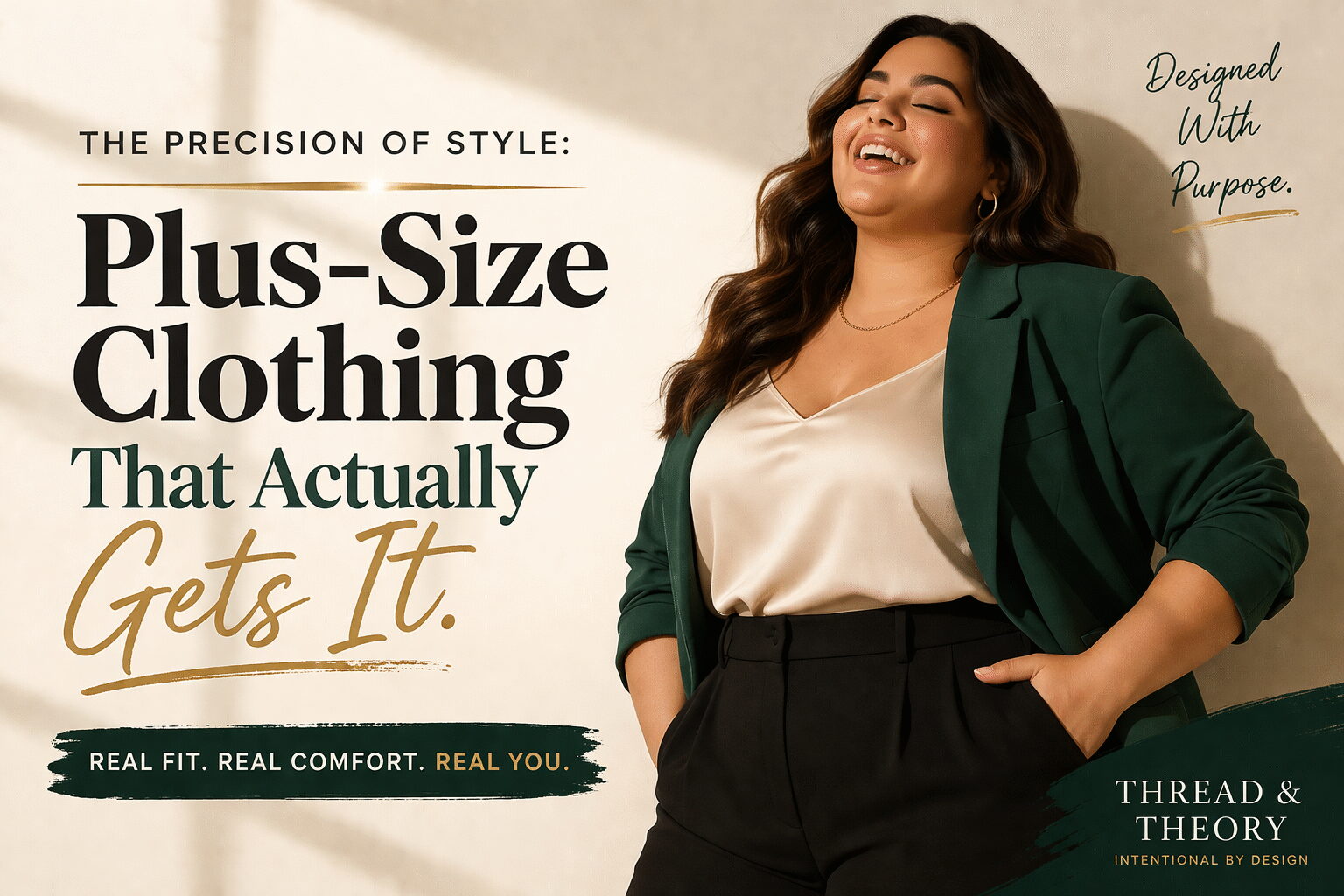
The Precision of Style: Why Modern Wardrobes Are Asking Better Questions

The Precision of Style: Why Modern Wardrobes Are Asking Better Questions

There was a time when getting dressed was simple in the most frustrating way. You either made it work, or you made peace with it not quite working. Sleeves pulled a little here, waistlines negotiated aggressively there, and somehow “it fits” became a very flexible definition of truth.

But clothing has quietly entered a new era. And it’s asking better questions.

Not “Does this kind of fit your body type?”
 But rather, “Why shouldn’t it?”

At Thread & Theory, we’ve spent a lot of time thinking about that shift. Not in a dramatic runway-voice kind of way—but in the everyday reality of standing in front of a mirror five minutes before leaving the house, wondering if confidence can be steamed out of fabric like wrinkles.

When Clothing Stopped Behaving and Started Performing

Modern wardrobes are no longer just about covering the body. They’ve become part toolkit, part identity, part emotional support system (though admittedly, not the kind that texts back immediately).

People want clothing that moves with them, not against them. Fabric that doesn’t surrender after one long day. Silhouettes that don’t require a full-time negotiation between comfort and structure.

And yet, for a long time, fashion acted like those expectations were… optional.

As if comfort, variety, and elegance couldn’t possibly exist in the same garment without causing some kind of aesthetic imbalance in the universe.

We disagree.

The Problem with “One Idea of Fit”

The biggest issue in clothing design isn’t sizing—it’s assumption.

The assumption that bodies should adapt to patterns instead of patterns adapting to bodies.

That’s where things usually go wrong. Clothing becomes a math problem instead of a design experience. Add a little here, stretch a little there, hope for the best, and call it “inclusive.”

But real inclusivity doesn’t come from scaling up a base idea. It comes from rethinking the idea entirely.

Fit is not just measurement. It’s relationship. Between fabric and movement. Between structure and ease. Between what you expect from clothing and what it actually delivers at 3 p.m. on a very long Tuesday.

Variety Isn’t a Luxury—It’s the Minimum

One of the quieter frustrations in modern fashion is repetition disguised as choice.

Different colors, same idea. Different names, same silhouette. A wardrobe that feels like it’s been photocopied with slightly different lighting.

But personal style doesn’t live in repetition. It lives in range.

Some days ask for structure. Some days ask for ease. Some days ask for something that simply makes you feel like you have your life together—even if your inbox strongly disagrees.

That’s where thoughtful variety matters. Not more of the same, but more ways to feel like yourself.

When Design Starts Paying Attention

Good clothing design is a bit like good conversation. You notice it most when it’s attentive.

Seams that don’t fight your movement. Fabrics that don’t give up halfway through the day. Shapes that don’t try to “fix” anything, but instead understand how to work with what’s already there.

It’s not about exaggeration. It’s about precision. The kind that doesn’t announce itself loudly, but quietly improves everything it touches.

And yes, sometimes it feels a little like the garment knows what it’s doing more than you do. That’s usually a good sign.

A Wardrobe That Doesn’t Ask You to Compromise

At Thread & Theory, the goal has never been to overwhelm with complexity or hide behind design jargon.

It’s simpler than that.

Clothing should feel like it belongs in your life without negotiation.

Not something you “get away with wearing,” but something you reach for without second thoughts.

The kind of piece that makes getting dressed less of a daily debate and more of a small, satisfying decision.


The Quiet Shift

Fashion doesn’t always change loudly. Sometimes it shifts in quieter ways—like realizing you don’t have to choose between structure and comfort. Or that variety doesn’t have to mean confusion. Or that clothing can actually keep up with real life instead of just observing it from a distance.

And once you notice that shift, it’s hard to go back.

Because suddenly, the question is no longer “Does this work on me?”

It becomes “Why hasn’t it always been like this?”

Leave a Reply

Your email address will not be published. Required fields are marked *